

Contributors: Annika Sundberg (UC Berkeley), Chloe Margulis (UC San Diego), Corra Nordheim (UC San Diego), Jolene Marie Ku (UC Davis), Leanna Chin (UC San Diego), 2024 blog writing contestants
You’ll take thousands of photos during your study abroad semester—that’s a given. But what about the inside jokes with your roommates, the taste of that life-changing pastry from the corner bakery, or the moment you realized you could navigate a foreign city on your own? Those details fade faster than you’d think, and a camera roll full of unorganized photos won’t bring them back.
The good news? Students have found creative ways to capture not just what they saw, but how they felt and who they became during their time abroad. From weekly blog posts to leather-bound journals, travel videos to photography projects, these five UC students discovered documentation methods that fit their personalities and actually stuck.
Here’s what worked for them—and what might work for you.
1. Start a Blog or Digital Diary (Chloe’s Story)
Before Chloe set out for Barcelona, Spain, she had an idea brewing: starting a blog. Though this wouldn’t be just any blog—this would be “Chlo and Behold,” a virtual scrapbook of her upcoming adventures. The anticipation of documenting her time abroad gave her the final push to officially kick it off.
Every Monday, she recapped the week before, sharing photos and her experiences from picturesque architecture to tantalizing tapas. Creating the digital diary allowed her to document everything she did while visiting different countries and cities on the weekends.
Every Monday, I would post a recap of the week before, sharing my photos and experiences of the picturesque architecture to the tantalizing tapas. Not only did this serve as a personal keepsake, but it also kept my friends and family across the pond in the loop.
The beauty of a blog is that it keeps everyone updated without the constant need for phone calls or long text threads. Your family gets to live vicariously through you as you navigate new cultures, face new challenges, and explore every nook and cranny of your host city. It’s the perfect balance—keeping them in the loop without sacrificing your adventure time.
Why blogging works
Connection without constant communication. Studying abroad is a whirlwind, and it’s easy to get caught up in the excitement of exploration. A blog lets you share your experiences on your own schedule, so you’re not fielding the same questions from 10 different people.
Memory preservation you can search later. Writing weekly recaps cements every memory in a way that scrolling through photos doesn’t. Whether you’re reminiscing about a specific country or recalling how you felt during a particular experience, your blog becomes a personal time capsule. Plus, when friends ask for advice later, you can easily check back and give detailed recommendations.
Alternative digital documenting options
While writing a blog can be a public window into your adventures, many students also keep a private journal for more intimate reflections. Chloe did both—her blog captured the highlights while her journal recorded her thoughts and feelings, capturing the essence of her personal growth, which was sometimes absent from the polished posts.
Chloe wasn’t alone in finding digital ways to document her experience. Her friends found their own platforms too.
TikTok: The go-to platform for quick and entertaining snippets of life. Some of Chloe’s friends posted day-in-the-life or even week-in-the-life videos of their routines, adventures, and occasional mishaps. Short-form video is perfect if you’re more visual.
Instagram: Many students create Instagram accounts dedicated to their study abroad experiences. They post daily, weekly, or simply when they experience something especially significant. Each post becomes a snapshot of their journey, shared through carefully curated photos and captions.
Private photo albums: Not into public sharing? Create a shared album on Google Photos or iCloud that only the family can access. Pro tip: Add captions to photos as you take them, so you can remember the context later.
The platform doesn’t matter as much as finding something that fits your style and that you’ll actually use. If writing feels like homework, try video. If you hate being on camera, stick to photos and captions. The best documentation method is the one you’ll keep up with consistently.
2. Keep a Physical Journal or Scrapbook (Annika’s and Leanna’s Stories)
There’s something special about holding your study abroad memories in your hands. Two students discovered that a physical journal or scrapbook became more than just documentation—it became a companion, a creative outlet, and a way to truly be present in their new homes.
The classic: A leather-bound time capsule
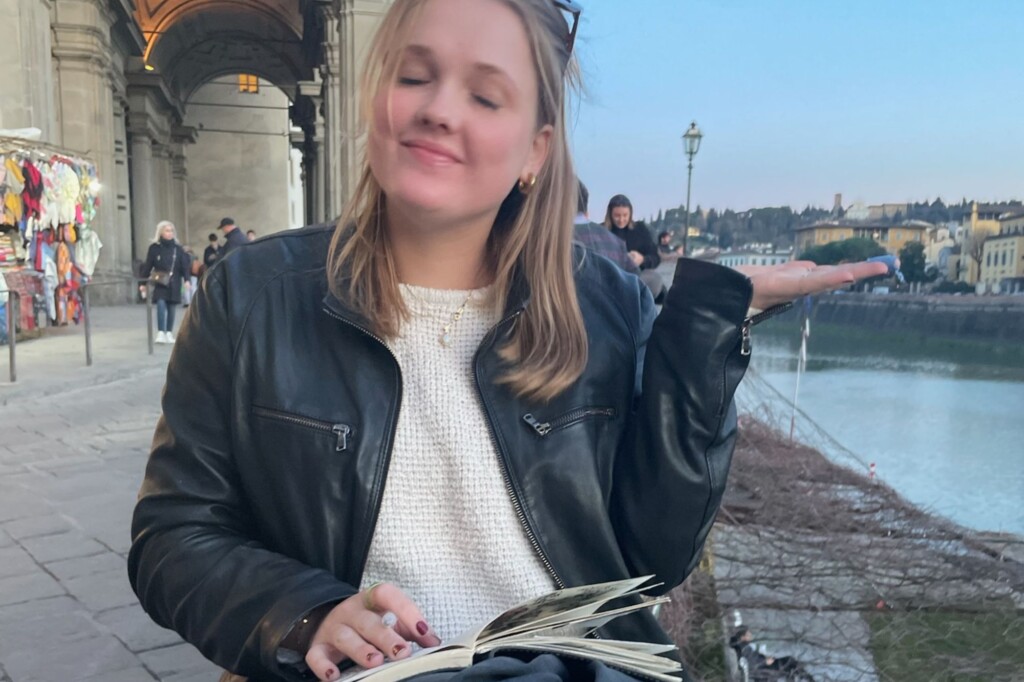
On the second day of her semester in Florence, Italy, Annika was perusing the many street markets of leather goods when she found it. There, on the wooden booth of one of the merchants amidst purses and wallets and belts, lay a stack of leather journals. Despite her excitement about being in Italy, she was admittedly overwhelmed and scared out of her mind. She remembers the feeling of love at first sight when she first pulled her journal from that stack—a navy blue book bound in leather and embossed with the emblem of a lily, the symbol of Florence.
For five months, Annika’s journal never left her side. It traveled with her to nine different countries by every mode of transportation imaginable—trains, planes, buses, gondolas, taxis, cars, and boats. Along the way it collected stories as well as receipts, photos, postcards, sketches, and stickers from all across Europe.
Many of my journal entries I imagine as a report about my experiences to myself 20 years in the future. Essentially what I created for myself is a study abroad time capsule that is filled with my unequivocally candid and unfiltered thoughts and experiences.
What went into the journal
Annika didn’t just write—she created. Her journal became a multimedia scrapbook that captured every dimension of her experience. She documented everything from restaurant reviews and opinions on new foods she tried to small phrases to remember in Italian to inside jokes with friends.
Her sunny afternoons in Florence were spent in sprawling green gardens, sketching marble statues or friends lying on picnic blankets beside her. On rainy days, she frequented local cafés where she would confide in her journal about her struggles with homesickness, sitting at a table for one and sipping a cappuccino while writing to her future self about missing her boyfriend and In-N-Out hamburgers.
The journal also doubled as a place for class assignments and expressing her passion for visual arts. She would spend hours at night in her dorm with a glue stick and a small photo printer curating collages alongside her entries. Her Introduction to Drawing class assignments appeared in the book alongside her personal notes and collages—sketches of museum artworks and assigned subjects mixed with her own observations.
How the journal changed her experience
The journal didn’t just document Annika’s time abroad—it actively shaped it. Her little blue book and favorite pen brought her to meet new people and observe corners of the city she might have otherwise never truly seen. At many cafés, she returned so often that she became friends with the staff, who would greet her by name every time she walked through the doors.
Not only did it give me a way to reflect on my time abroad, but it also gave me a way to be present in my surroundings and to really observe both the city of Florence and the people and scenes from my travels.
The meticulous record-keeping allowed her to physically see the development of deep friendships. She’d mention one person in her journal and 10 pages later, she’s talking about how they sang karaoke at a local bar together or went on an unexpected weekend trip. It made her more engaged and spontaneous, more willing to go outside her comfort zone because it showed her how rewarding being uncomfortable can be.
When her program in Florence ended, Annika took her journal with her on a two-week solo travel adventure throughout Britain, the Netherlands, and France. It was just her and her little blue book against the world. In those two weeks, the journal taught her a life lesson she didn’t think would be so hard—how to be alone. She emerged from that experience a more confident and independent person, and her journal entries from that time only confirm it.
A low-maintenance alternative: Bullet-point scrapbooking

0 Comments